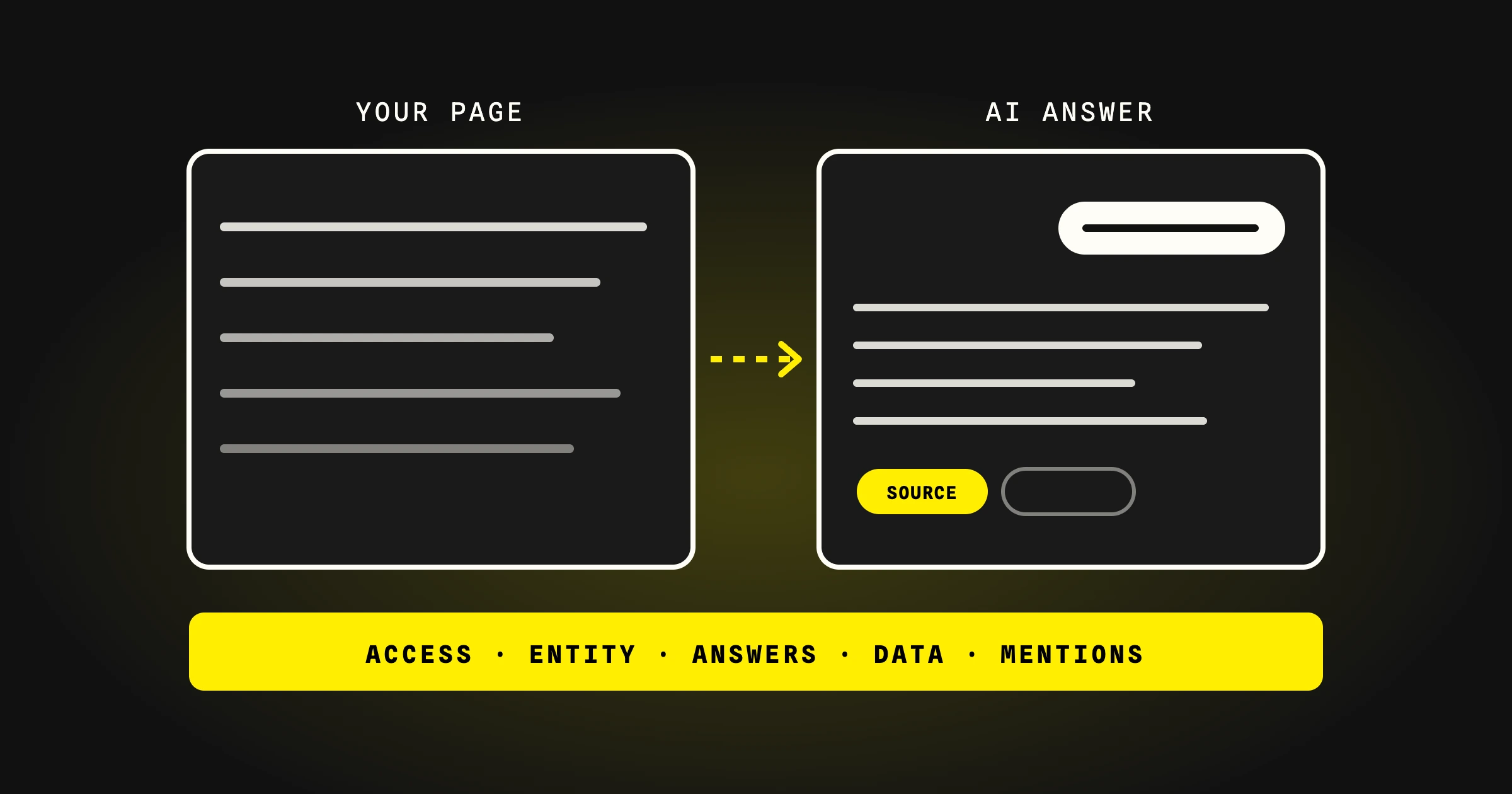
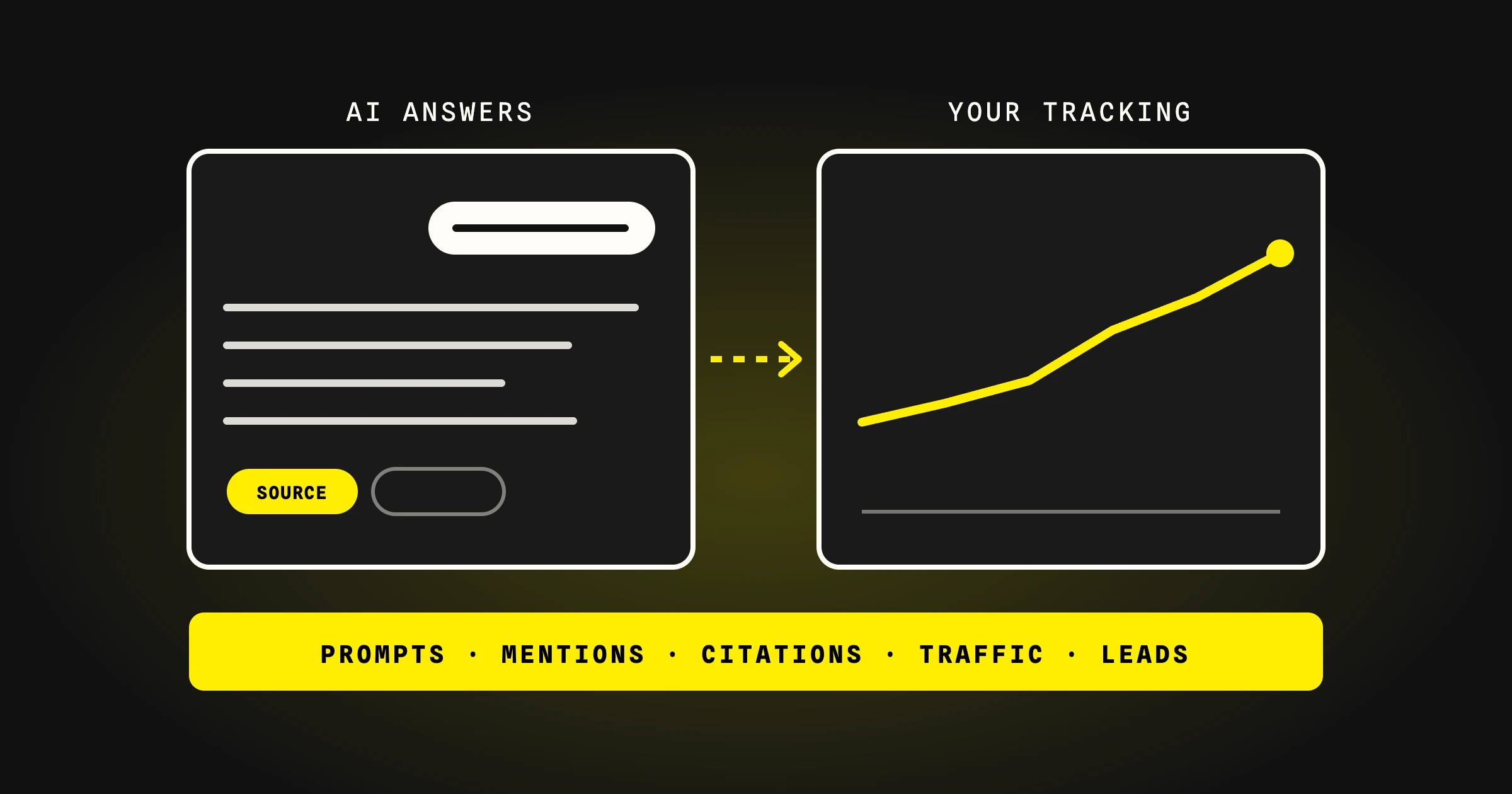
To get cited in AI answers, make sure each AI engine can reach your pages, state clearly who your company is, open every section with a direct answer, publish data others can quote, and earn brand mentions on the sites your buyers read. Ranking in Google still helps, but it no longer decides who gets cited.
In short
Access comes first: ChatGPT needs OAI-SearchBot allowed, Perplexity needs PerplexityBot, and Google needs the page indexed and snippet-eligible.
Write a 40 to 60 word answer under each question-style heading, with the source and year for every number.
Only 38% of Google AI Overview citations now come from top-10 pages, so a page that answers well can be cited without ranking first.
Brand mentions track AI visibility far more closely than backlinks do.
AI Overview citations from top-10 pages
38%
of Google AI Overview citations came from pages ranking in the top 10, down from 76% in July 2025 (Ahrefs, March 2026)
Visibility gain from GEO methods
Up to 40%
higher visibility in generative engine responses from methods such as adding statistics and citations (Aggarwal et al., KDD 2024)
Mentions vs AI visibility
0.664
correlation of brand mentions with AI Overview visibility, vs 0.218 for backlinks (Ahrefs, 2025)
How Do AI Answers Choose What to Cite?
AI answer engines read several pages, pull out the passages that answer the question, and name a few of them as sources. The work of becoming one of those sources is called answer engine optimization (AEO) or generative engine optimization (GEO). GEO here means generative engine optimization, not local geo-targeting.
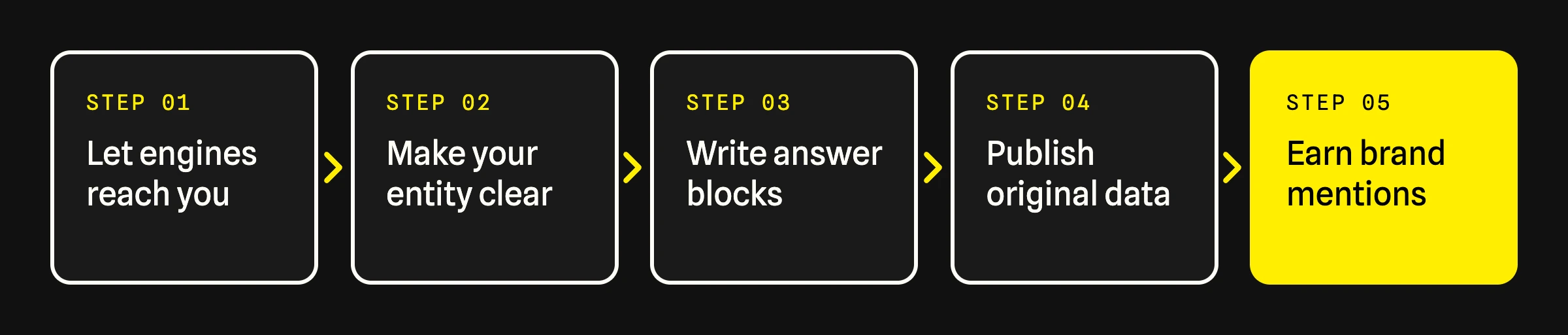
Our guide to what AEO is explains how the engines pick sources. This guide is the how-to: five steps, in the order they pay off.
The five steps, in order.
Step 1: Can Each AI Engine Reach Your Pages?
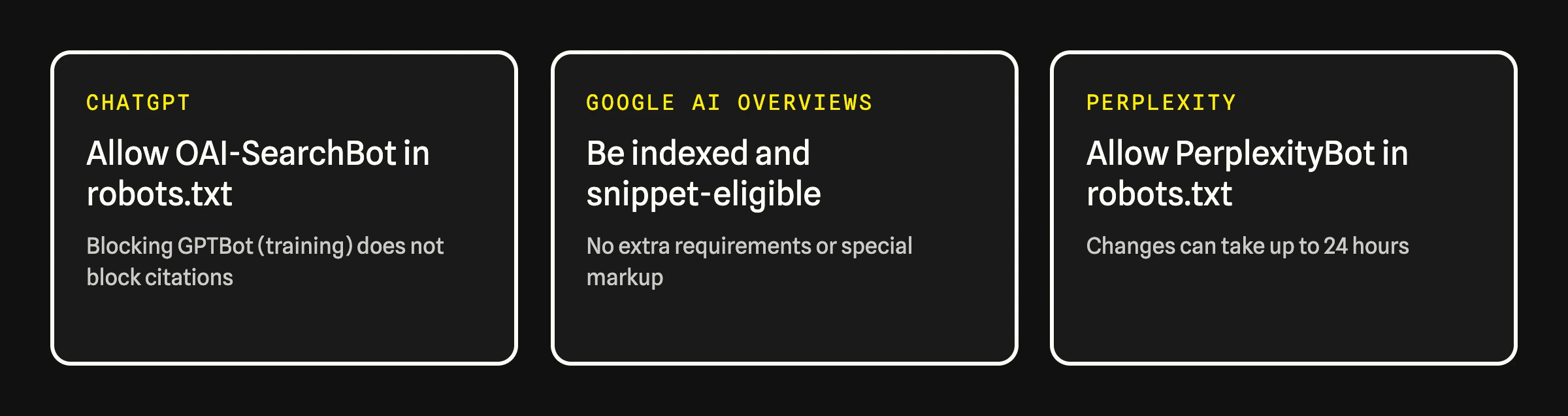
An engine cannot cite a page it cannot read. Each one has its own rule, published in its own documentation.
Engine
What it needs
What to check
ChatGPT search
OAI-SearchBot allowed in robots.txt
OpenAI says sites that opt out of OAI-SearchBot will not be shown in ChatGPT search answers. Changes take about 24 hours.
Google AI Overviews and AI Mode
The page indexed and eligible for a snippet
Google states there are no additional requirements and no special optimizations.
Perplexity
PerplexityBot allowed in robots.txt
Perplexity recommends allowing it so your site appears in its results. Changes can take up to 24 hours.
One point causes confusion. OpenAI runs a separate crawler, GPTBot, for model training. Blocking GPTBot does not remove you from ChatGPT search, and allowing it does not get you cited. The two settings are independent.
If pages are slow, blocked or not indexed, fix that first. It is technical SEO work, and nothing below helps until it is done.
Step 2: Do AI Engines Know Who You Are?
AI systems are careful about naming companies they cannot verify. Make your company an entity they can recognize.
One description everywhere. The same company name, what you do and who you serve on your site, LinkedIn, directories and review sites.
Organization schema. Mark up your company with links to its official profiles.
Named authors. Put a real person with a role and a profile on every guide.
Consistent service names. Call each service the same thing on every page.
Step 3: Write Answer Blocks AI Can Quote
AI engines lift passages, not pages. Give them a passage that stands on its own.
Answer first. A 40 to 60 word answer directly under each main heading.
Headings as questions. Use the words a buyer would type or say.
One claim per sentence. Short sentences survive extraction.
Numbers with a source and a year. Unattributed figures get passed over.
Tables for comparisons. They are easy to lift into an answer.
A visible updated date. Keep it true by revisiting the page.
Before
After
In today's digital landscape, businesses face increasingly complex challenges when it comes to search visibility.
Technical SEO is the work of making a website easy for search engines to crawl, index and understand. It covers site speed, mobile usability, structured data, canonical tags and sitemaps.
Researchers who tested these methods on a benchmark of generative engines found that adding statistics, quotations and citations raised visibility in the responses by up to 40%.
Step 4: Publish Original Data
An answer engine needs a reason to cite you and not the page you are both summarizing. First-hand numbers are that reason: results from your own audits, benchmarks from your client work, a survey of your market. State the sample, the date and the method, so the figure can be quoted with confidence. For an example, see what our 122 site audits show.
One good number beats ten opinions. A single figure with a clear sample and date is more likely to be quoted than a page of general advice.
Step 5: Earn Brand Mentions, Not Only Backlinks
In Ahrefs' study of 75,000 brands, branded web mentions correlated with AI Overview visibility at 0.664, against 0.218 for backlinks. AI systems appear to weigh how often trusted sources talk about you, with or without a link.
0.664
Ahrefs · 75,000 brands, 2025
Correlation between branded web mentions and visibility in Google AI Overviews. Backlinks scored 0.218. Correlation is not proof of cause, but it shows where to spend effort.
For a B2B company, mentions come from:
Industry publications that quote your data or your people.
Podcasts and webinars that publish transcripts.
Review sites and directories your buyers check.
LinkedIn and community discussions where your team answers questions.
Does Ranking in Google Still Matter?
Yes, but less than it did. Ahrefs found that 38% of Google AI Overview citations came from pages ranking in the top 10, down from 76% in July 2025, and 31% came from pages outside the top 100. Good rankings still put you in the pool. A clear, quotable answer is what gets you picked from it.
Run a fixed set of buyer questions through each engine every month and record who gets cited. Our guide on how to measure AI visibility covers the prompt set, the metrics and the report.
The AI Citation Checklist
OAI-SearchBot and PerplexityBot are allowed in robots.txt.
Key pages are indexed in Google and eligible for snippets.
Pages load fast and work on mobile.
Organization schema is in place and matches the page.
The company is described the same way on every profile.
Every guide has a named author.
Each main heading is a question a buyer asks.
A 40 to 60 word answer sits under each heading.
Every number has a source and a year.
Comparisons are in tables.
At least one page publishes your own data.
A monthly prompt check tracks who gets cited.
The Bottom Line
Getting cited is not a trick. Engines cite pages they can reach, from companies they can identify, with answers they can quote and numbers they can trust. Work through the five steps on the pages that already bring in leads.
Our AEO audit checks what AI assistants say about you today, and our AEO agency team makes the changes. Or start with a free SEO report.
FAQ
Can you pay to be cited in ChatGPT?
No. Citations in ChatGPT search answers are not sold. OpenAI states that any public website can appear in ChatGPT search as long as it does not block OAI-SearchBot.
Does schema markup get you into AI Overviews?
Not on its own. Google states there are no additional requirements or special optimizations for AI Overviews. Schema that matches the page helps search engines understand it, which supports the basics.
How long until a new page gets cited?
It varies by engine and by how often your site is crawled. Engines that search the web live can pick up a page soon after it is indexed. Check monthly with a fixed prompt set to see when you appear.
Does blocking GPTBot stop ChatGPT from citing me?
No. GPTBot is OpenAI's training crawler. ChatGPT search uses OAI-SearchBot, and the two settings are independent. You can block GPTBot and still allow OAI-SearchBot.
5.0 on Clutch · 350+ companies served
Get a Free SEO Report.
A senior strategist reviews your site and walks you through it on a 30-minute call. No sales pitch, and you keep the report either way. It includes:
Andrés founded Digital Socios and Glued and leads Digital Socios' AI search work. He has spent 8+ years building websites and user experiences for brands like Nestlé, Vital Proteins and Pfizer.