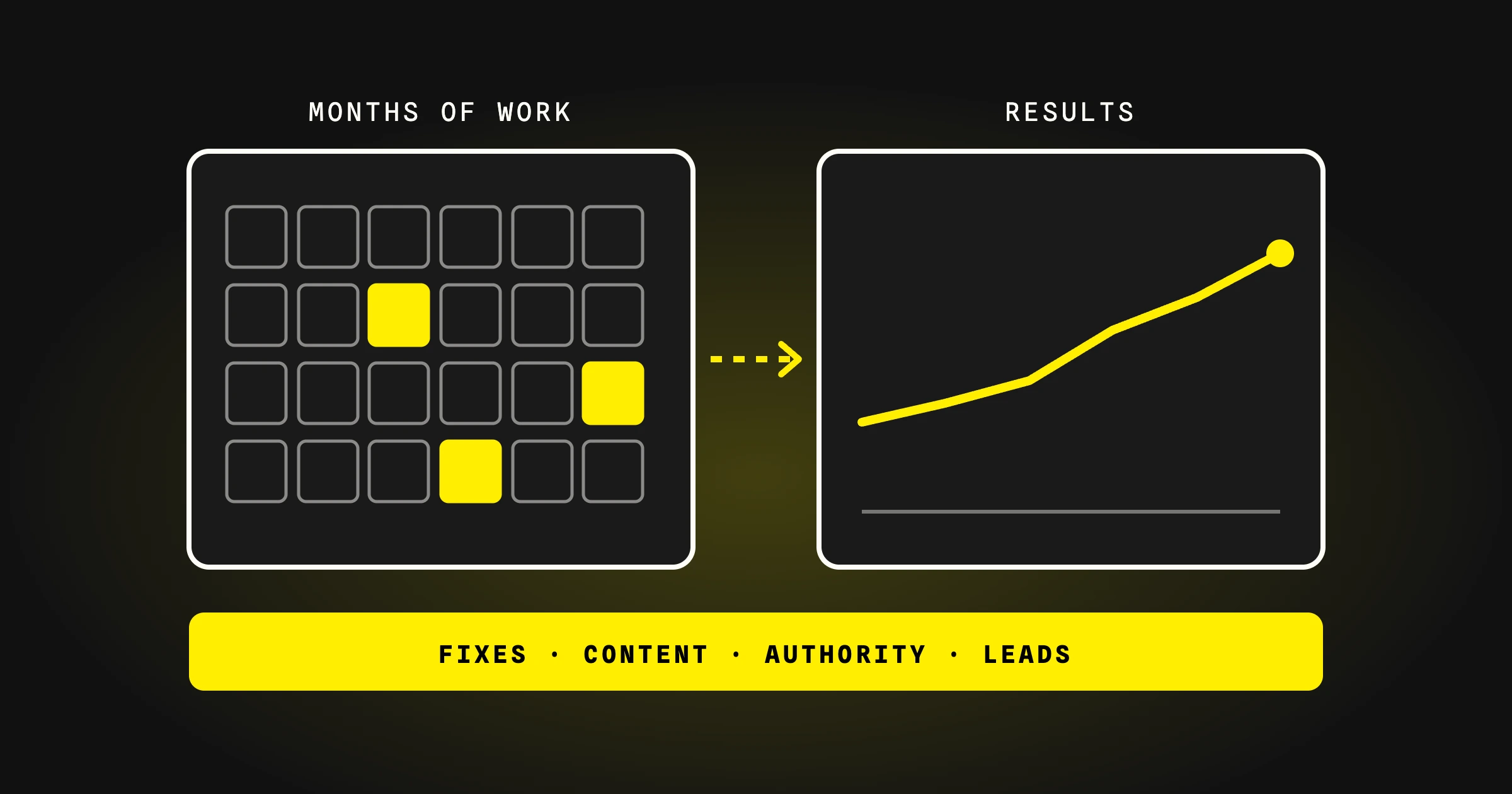
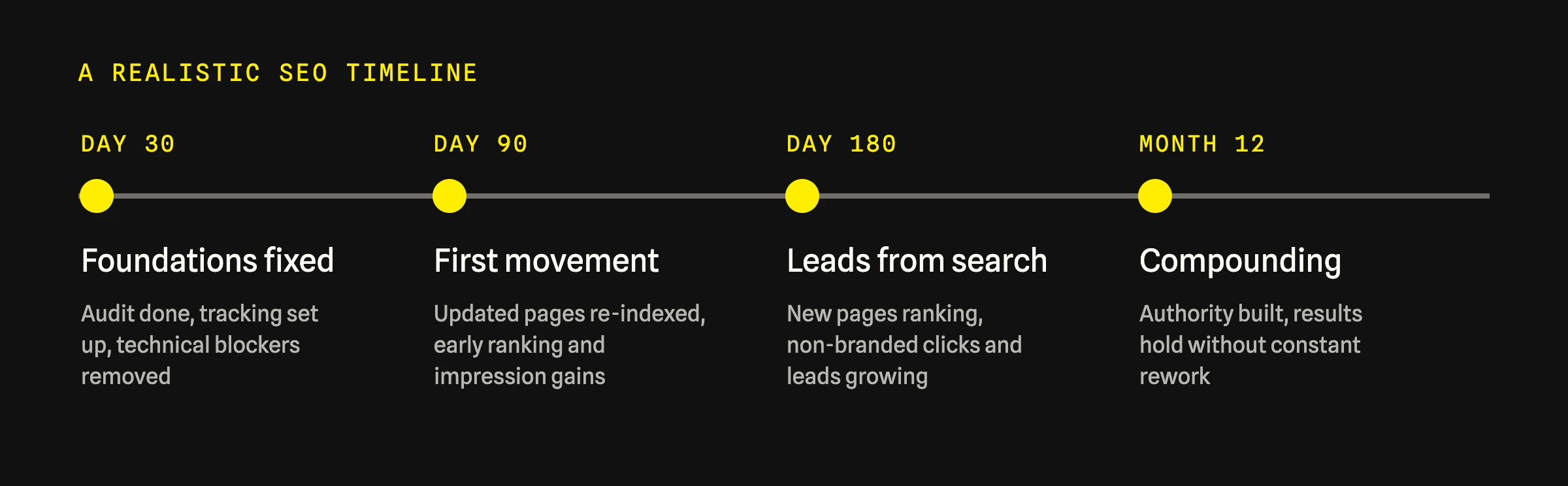
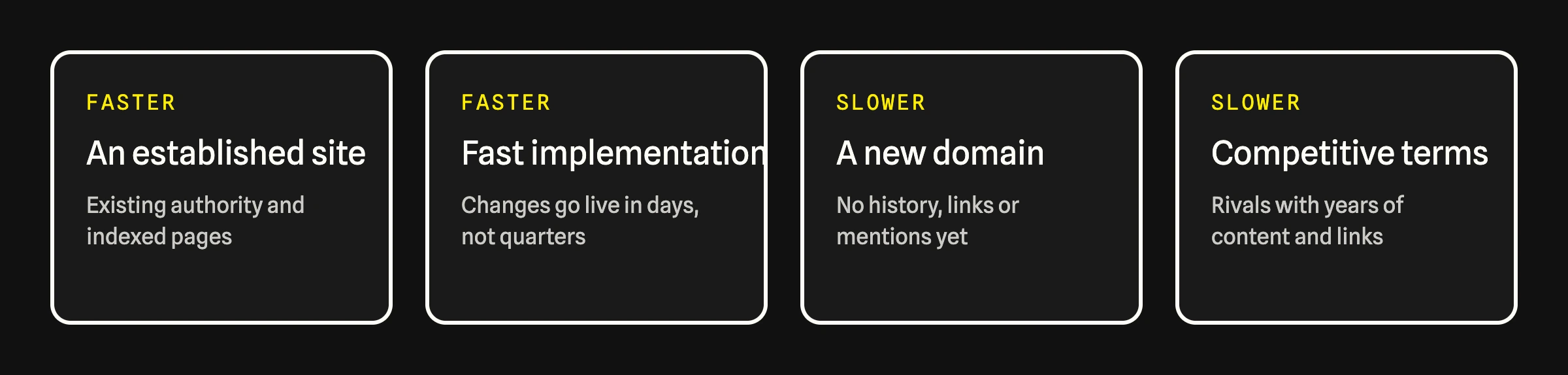
SEO usually takes four to twelve months to show business results. Expect the foundations fixed in the first 30 days, first ranking and impression gains by day 90, and growing leads from search by day 180. An established site with fast implementation moves quicker; a new domain in a competitive market takes longer.
In short
Google's own estimate is four months to a year to implement improvements and see the benefit.
Day 30 is foundations, day 90 is first movement, day 180 is leads, month 12 is compounding.
Only 6.11% of new pages reach Google's top 10 within a year, so updating pages that already rank is the fastest win.
Before leads arrive, watch indexed pages, impressions and non-branded clicks.
Google's own estimate
4 to 12 mo
the time SEOs need to implement improvements and then see potential benefit, according to Google's Maile Ohye (2017)
New pages in the top 10 within a year
6.11%
of 2 million newly published pages reached Google's top 10 within a year (Ahrefs, 2025)
Average age of the #1 result
5 years
average age of the page ranking first, up from 2 years in 2017 (Ahrefs, 2025)
The Short Answer
Plan for four to twelve months. That range comes from Google itself: in its video on hiring an SEO, Google's Maile Ohye said that "in most cases, SEOs need four months to a year" to implement improvements and then see the benefit. Where you land in that range depends on your site's history, your competition and how fast changes go live.
4 to 12 months
Google · How to hire an SEO, 2017
Google's own estimate of the time needed to implement SEO improvements and then see potential benefit. Anyone promising results in weeks is ignoring it.
What Does a Realistic SEO Timeline Look Like?
Results arrive in stages. Each stage has work you should see done and a signal you should see move.
What to expect at each stage.
When
Work you should see done
Signal you should see move
Day 30
Audit finished, tracking and key events set up, technical blockers fixed
More pages indexed, fewer crawl errors
Day 90
Money pages rewritten, first new pages live, schema in place
Impressions up, first ranking gains on commercial terms
Day 180
Content plan running, mentions and links being earned
Non-branded clicks and leads from search growing
Month 12
Program maintained and refreshed
Results hold and compound; cost per lead falls
Why Does SEO Take This Long?
Three things set the pace, and none of them can be bought.
Google has to re-crawl and re-assess your pages. A fix made today is not judged today.
The pages you compete with are old. Ahrefs found the average page ranking first is 5 years old, and 72.9% of pages in the top 10 are more than 3 years old.
New pages rarely rank fast. In Ahrefs' study of 2 million newly published pages, 6.11% reached the top 10 within a year.
There is good news in the same study: of the pages that did reach the top 10, 40.82% got there within a month. Strong pages on a trusted site can move quickly. That is why the fastest wins usually come from improving pages that already rank, not from publishing new ones.
What Speeds SEO Up or Slows It Down?
Factor
Faster when
Slower when
Site history
The domain has years of indexed pages and links
The domain is new
Implementation
Changes go live within days
Fixes wait in a developer queue
Competition
You target specific, lower-volume buyer searches
You chase the broadest terms in your market
Starting point
Good pages are held back by fixable technical issues
The site needs most of its content written
Approvals
One person signs off content
Every page goes through a committee
Implementation speed is the factor you control. The same recommendations take three months at one company and twelve at another. The difference is how fast changes reach the live site.
How Do You Know SEO Is Working Before the Leads Arrive?
Leads are the goal, but they lag. These signals move first, roughly in this order:
Indexed pages. More of your important pages appear in Google Search Console's indexing report.
Impressions. Your pages show up for more searches, even before clicks rise.
Rankings on commercial terms. The searches buyers make before they choose a provider.
Non-branded clicks. Visits from people who did not search for your name.
AI citations. Your pages named in AI answers for your buyers' questions.
Leads from organic search. Key events in Google Analytics 4.
If the first three are moving by day 90, the program is on track. To turn those signals into a number leadership will accept, see how to measure SEO ROI.
Does AI Search Change the Timeline?
It adds a second way to be found. AI answers draw on pages that are already indexed, so a clear, well-structured page can be cited without ranking first. The work is the same work: pages that can be crawled, answers that can be quoted. Our guide on how to get cited in AI answers covers the steps.
When Should You Worry?
At day 30: there is no audit, no plan and no tracking.
At day 90: recommendations exist but nothing has changed on the site.
At day 180: reports show rankings, but nobody can show leads.
Slow results with visible work are normal. No visible work is not. If you are unsure which one you have, an independent SEO audit will tell you, and our guide on how to choose an SEO agency lists the questions to ask.
The Bottom Line
SEO takes four to twelve months because Google has to re-assess your site against pages that have been earning trust for years. Judge the first 90 days by the work done and the early signals, and the first year by leads. If you need leads before then, see SEO vs PPC for how ads can cover the gap.
What you pay shapes how much gets done each month: see SEO pricing for the common models. To see where your site stands today, start with a free SEO report.
FAQ
Can SEO work in 30 days?
Technical fixes can show within weeks, and a strong page on a trusted site can rank quickly. But business results in 30 days are rare. Google's own estimate is four months to a year.
How long does SEO take for a new website?
Longer than for an established one. A new domain has no history, links or mentions, so plan for the upper end of the four to twelve month range before search becomes a steady source of leads.
Does SEO stop working if we stop investing?
Not overnight. Pages that rank keep bringing visits for a while, but competitors keep publishing and content goes out of date. Without upkeep, results usually fade over the following months.
Is SEO faster than it used to be?
No. Ahrefs found the average page ranking first is now 5 years old, up from 2 years in 2017. Established pages hold their positions longer, which makes fast wins for new pages less common.
5.0 on Clutch · 350+ companies served
Get a Free SEO Report.
A senior strategist reviews your site and walks you through it on a 30-minute call. No sales pitch, and you keep the report either way. It includes:
Andrés founded Digital Socios and Glued and leads Digital Socios' AI search work. He has spent 8+ years building websites and user experiences for brands like Nestlé, Vital Proteins and Pfizer.