We reviewed 122 SEO audits that Digital Socios produced in 2025. Two thirds of the sites had basic on-page errors such as missing H1s, canonical tags or duplicate titles, and half depended on people already searching for their brand name. The most costly mistake was not technical: it was being invisible for the searches buyers make before they know you.
In short
66% of audited sites had basic on-page issues: missing or duplicate H1s, canonical tags, titles or meta descriptions.
51% relied on branded search. Where it was measured, a median of 80% of organic traffic came from people searching the company name.
58% of the sites received fewer than 1,000 organic visits a month.
37% had page speed or Core Web Vitals problems, and 26% had pages Google could not index properly.
Fix indexing first, then on-page basics, then speed, then build pages for the searches buyers make.
Sites with basic on-page errors
66%
of 122 audited sites had missing or duplicate H1s, canonical tags, titles or meta descriptions (Digital Socios audit data, 2025)
Sites relying on branded search
51%
of 122 audited sites depended on searches for their own brand name; median 80% of organic traffic where measured (Digital Socios audit data, 2025)
Sites under 1,000 organic visits a month
58%
of the 113 audited sites with traffic data received fewer than 1,000 organic visits a month; the median was 515 (Digital Socios audit data, 2025)
What Did We Look At?
In 2025 Digital Socios produced SEO audits for 122 companies across several industries. Each audit covers the site's technical health, its on-page setup, its content and where it appears in search. For this guide we went back through all 122 and counted how often each problem was reported as a finding.
A note on method, so you can judge the numbers:
Sample. 122 audit reports written in 2025. These are companies we audited, not a random sample of the web.
Counting. An issue counts once per audit if the report lists it as a finding. An issue that was not reported may still have been present.
Money figures. Dollar values are each audit's own estimate of the value of organic traffic the site was missing.
Names. No company is named. The figures are totals only.
What Are the Most Common SEO Mistakes?
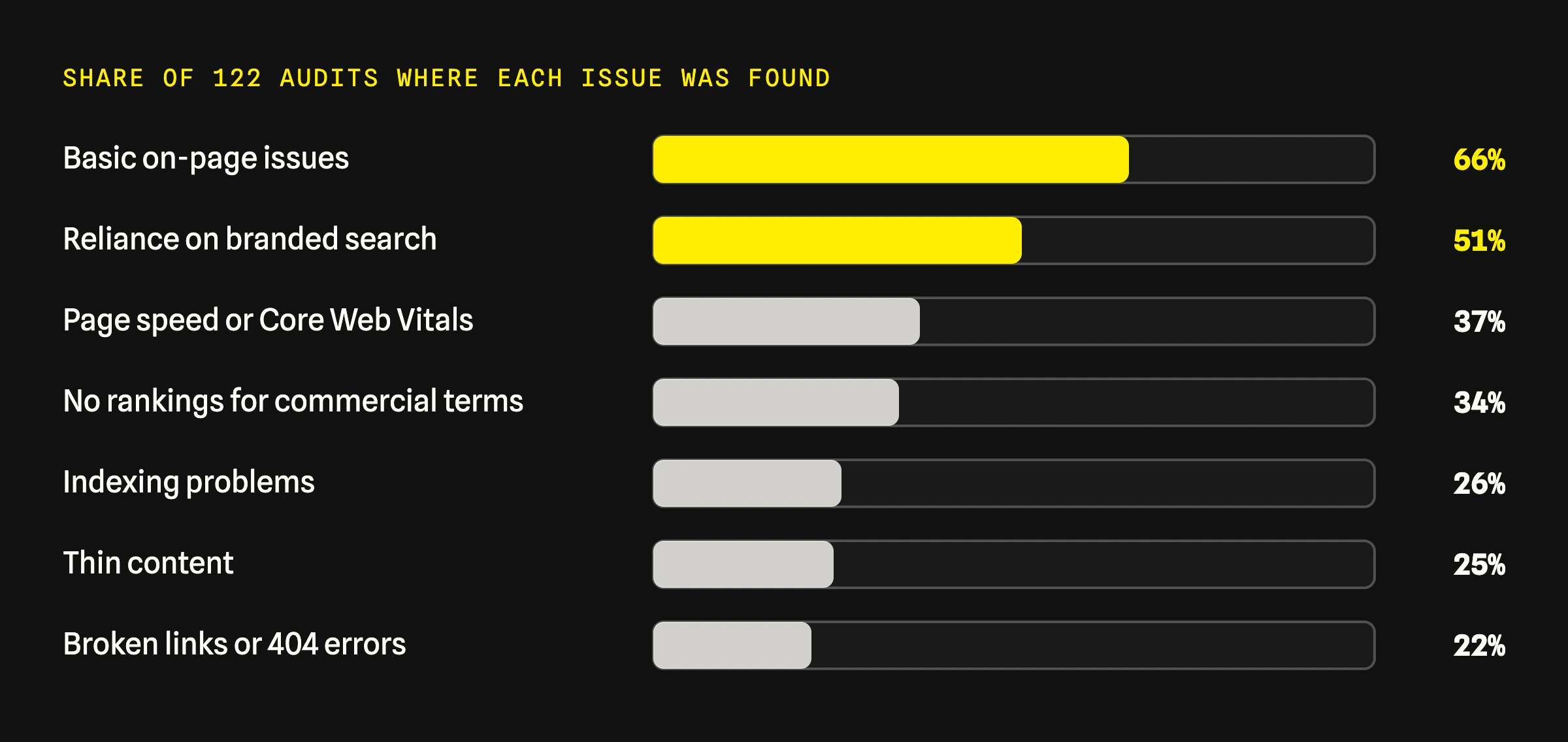
How often each issue appeared across 122 audits. Source: Digital Socios audit data, 2025.
Issue
Audits
Share of 122
Basic on-page issues (any of the three below)
80
66%
Missing, duplicate or multiple H1s
53
43%
Missing or wrong canonical tags
42
34%
Missing or duplicate titles and meta descriptions
42
34%
Reliance on branded search
62
51%
Page speed or Core Web Vitals problems
45
37%
No rankings for commercial keywords
41
34%
Indexing problems
32
26%
Thin content
31
25%
Broken links or 404 errors
27
22%
Mistake 1: Getting the On-Page Basics Wrong
Two thirds of the sites had at least one basic on-page error. The H1 was the most common: 43% of audits found pages with no H1, more than one, or the same H1 repeated across pages. Canonical tags and titles or meta descriptions each showed up in 34%.
These are the simplest things in SEO, and that is why they are missed. They are set once in a template, nobody checks them again, and every new page inherits the fault. The fix is usually a template change, not page-by-page work. See on-page SEO for how we handle it.
Mistake 2: Depending on Your Own Brand Name
Half the audits flagged reliance on branded search. In the 42 audits where the share was measured, a median of 80% of organic traffic came from people typing the company's name.
80%
Digital Socios · 122 audits, 2025
Median share of organic traffic that came from branded searches, in the 42 audits where it was measured. Those visitors already knew the company.
Branded traffic looks healthy in a report, but it is demand created by sales, ads and word of mouth. It says nothing about whether new buyers can find you. A third of the audits (34%) found no rankings at all for the commercial keywords in the company's market.
You can check this yourself in a few minutes. Our guide Is SEO dead? shows how to split branded from non-branded traffic in Google Search Console.
Mistake 3: Low Traffic Treated as Normal
Of the 113 audits with traffic data, 58% of the sites received fewer than 1,000 organic visits a month, and the median was 515. Many of these companies had real products, funding and customers. Their sites were simply not built to be found.
The audits also estimated what that costs. In the 42 audits that put a daily figure on missed organic traffic, the median was $422 a day, with the middle half between $132 and $855. These are estimates based on what the traffic would cost to buy, not measured revenue, but they show the scale of the gap.
Mistake 4: Slow Pages and Pages Google Cannot Index
Page speed or Core Web Vitals problems appeared in 37% of audits. Indexing problems appeared in 26%: pages blocked from Google, marked noindex by mistake, or lost behind redirects. Broken links or 404 errors appeared in 22%.
Indexing is the one to worry about. A slow page ranks lower. A page that is not indexed does not rank at all, and cannot be cited by an AI assistant either. This is technical SEO work, and it comes before everything else. Our technical SEO audit checklist lists the checks.
Mistake 5: Thin Content on the Pages That Matter
A quarter of the audits (25%) found thin content: service or product pages with a few lines of text and nothing a buyer or a search engine could use. These are often the pages closest to revenue.
A page for a commercial search needs to answer what the buyer is asking: what it is, who it is for, what it costs, how it works and why you. For how to plan that, see B2B content marketing for long sales cycles.
The common thread is visibility, not code. Most sites we audited worked. What they lacked was pages built for the searches buyers make before they know a brand. Technical fixes clear the way; they do not create demand.
What Order Should You Fix These In?
The order that pays off fastest.
Indexing and broken pages. Make sure Google can reach and index every page that matters. Fix 404s and redirects.
On-page basics. One H1 per page, a unique title and meta description, correct canonical tags. Fix them in the template.
Speed. Improve Core Web Vitals on your main page templates first.
Commercial pages. Build or rewrite the pages for the searches buyers make, then measure non-branded clicks and leads.
The first three are quick and finite. The fourth is where growth comes from, and it never really ends.
The Bottom Line
Across 122 audits the pattern was consistent: simple on-page errors on most sites, heavy reliance on brand searches on half, and low traffic accepted as normal. None of it is hard to fix. It is hard to see from the inside, because a site that works for people who know you looks fine to the people who built it.
If you want to know where your site stands on each of these, our SEO audit covers all of them and puts them in priority order. Or start with a free SEO report.
FAQ
What is the most common SEO mistake?
In our 122 audits it was basic on-page errors, found on 66% of sites. Missing, duplicate or multiple H1s were the single most frequent, at 43%, followed by canonical tag problems and missing or duplicate titles and meta descriptions at 34% each.
Why is relying on branded search a problem?
Branded searches come from people who already know your company. If most of your organic traffic is branded, search is not bringing you new buyers. In the audits where we measured it, a median of 80% of organic traffic was branded.
Which SEO problems should be fixed first?
Start with indexing and broken pages, because a page Google cannot index cannot rank. Then fix on-page basics in your templates, then page speed, then build pages for the searches your buyers make.
How was this data collected?
We reviewed 122 SEO audit reports that Digital Socios produced in 2025 and counted the audits in which each issue was reported as a finding. Dollar figures are the audits' own estimates of the value of missed organic traffic. No company is named.
5.0 on Clutch · 350+ companies served
Get a Free SEO Report.
A senior strategist reviews your site and walks you through it on a 30-minute call. No sales pitch, and you keep the report either way. It includes:
Digital Socios: analysis of 122 SEO audit reports produced in 2025 (own data; method described in this guide)
Andrés Esquivel
Founder & Chief Strategist, Digital Socios
Andrés founded Digital Socios and Glued and leads Digital Socios' AI search work. He has spent 8+ years building websites and user experiences for brands like Nestlé, Vital Proteins and Pfizer.