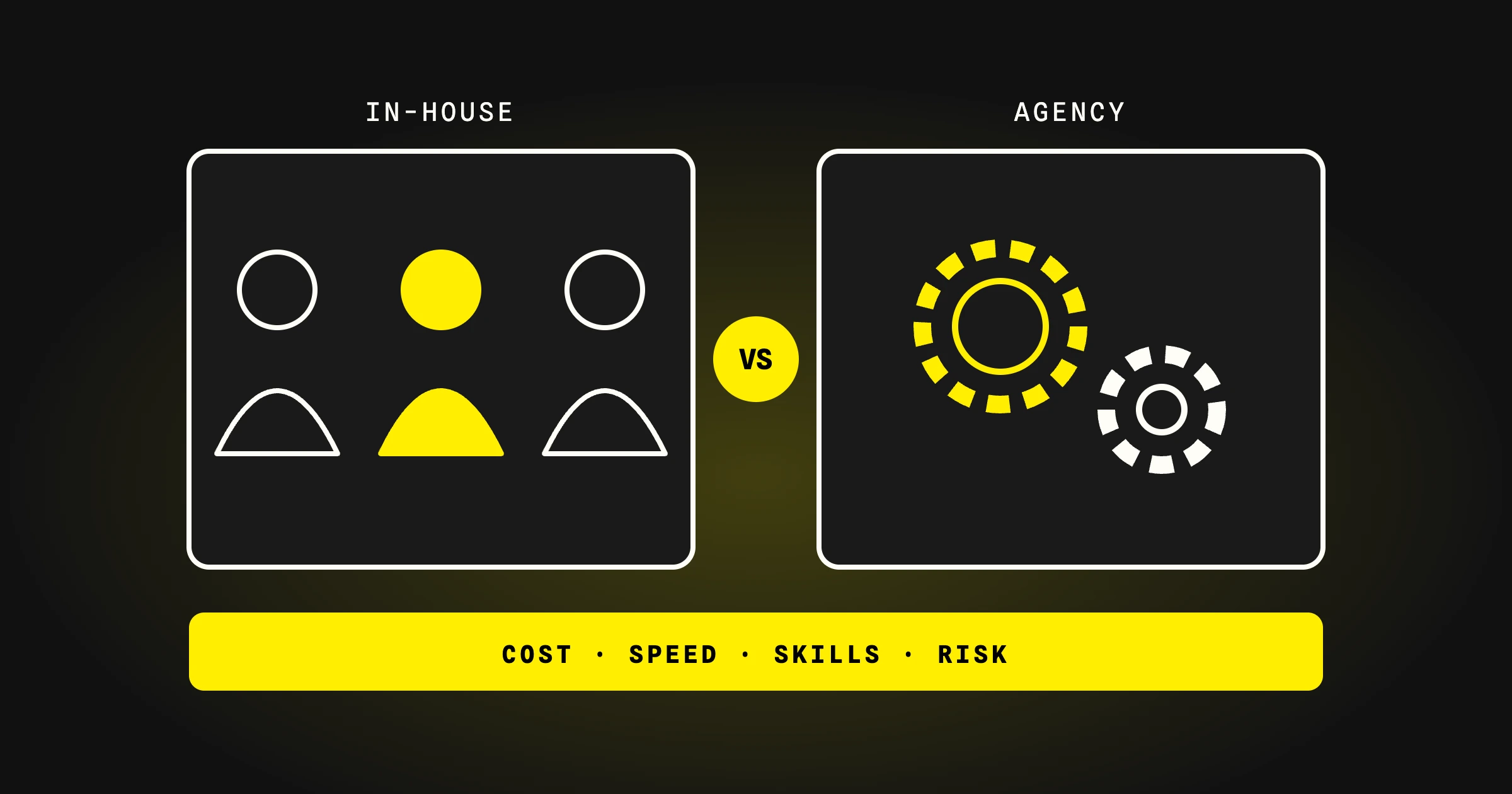
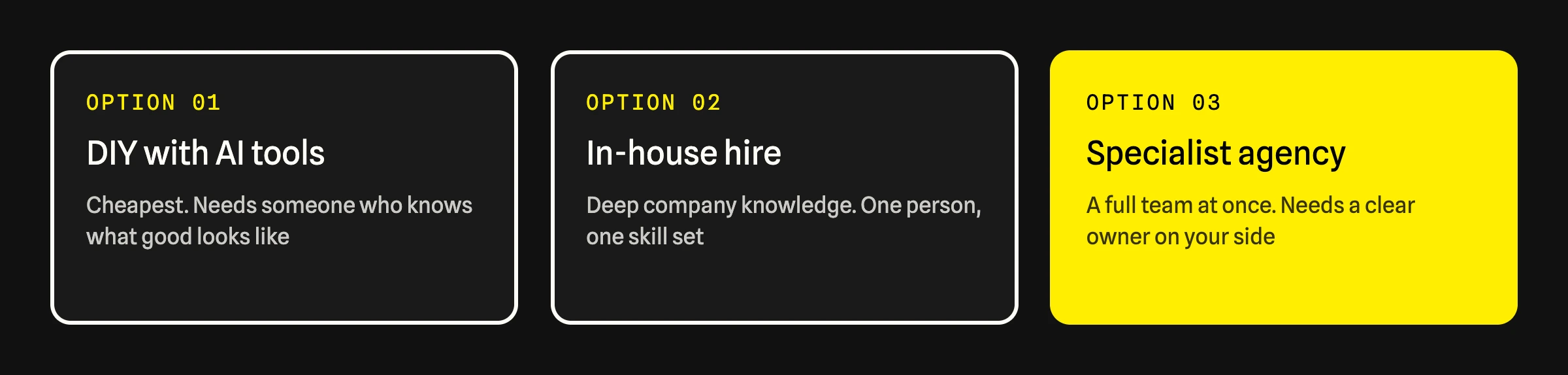
You have three ways to run SEO: do it yourself with AI tools, hire in-house, or use a specialist agency. DIY is cheapest but needs someone who knows what good looks like. An in-house hire brings company knowledge in one person. An agency brings a full team at once and needs a clear owner on your side.
In short
DIY with AI tools costs least in money and most in your team's time and risk of mistakes.
An in-house SEO costs a salary: the US median is about $66,000 before benefits and tools, for one person's skills.
An agency retainer averages about $3,209 a month in Ahrefs' survey and gives you strategy, technical, content and reporting skills together.
Many growth-stage companies start with an agency, then hire in-house to own the program once it is proven.
Whichever you choose, one person inside your company must own the result.
US median SEO salary
$66,000
median annual salary reported by US SEO professionals, before benefits and tools (SE Ranking salary survey, 2025)
Average agency retainer per month
$3,209
average monthly retainer for SEO agencies, Ahrefs' estimate from its pricing survey of 439 providers (2024)
B2B marketers using AI content tools
88%
of B2B marketers say their organization uses AI-powered content creation tools (Content Marketing Institute and MarketingProfs, 2026)
What Are Your Three Options?
The real choice is rarely agency or nothing. Most companies weigh three routes, and the cheapest one has changed in the last two years.
The three routes most companies weigh.
Factor
DIY with AI tools
In-house hire
Specialist agency
Cost
Tool subscriptions plus your team's time
A salary, benefits and tools
A monthly retainer
Time to start
Immediately
Months to recruit and onboard
Weeks
Skills covered
Whatever your team already knows
One person's strengths
Strategy, technical, content and reporting
Company knowledge
High
High
Has to be learned
Main risk
Mistakes nobody spots
One person leaves, the program stops
Reports without implementation
Fits best
Very early stage, small site
Search is already a core channel
Growth stage, need results without building a team
Can You Do SEO Yourself With AI Tools?
For parts of it, yes. AI tools are now standard: the Content Marketing Institute and MarketingProfs found 88% of B2B marketers say their organization uses AI content tools. They speed up keyword research, outlines, first drafts and data analysis.
The same survey shows the limit. The top challenges reported were ensuring accuracy (54%) and maintaining quality control (54%). AI produces work quickly. It does not tell you whether the work is right for your market, and it does not do these things at all:
Decide which searches are worth winning for your business.
Fix your site: indexing, speed, structure, redirects.
Earn mentions and links from other sites.
Take responsibility when traffic drops.
DIY works when the site is small, the stakes are low and someone on the team can judge the output. It breaks when nobody can tell a good recommendation from a harmful one. If you go this route, start with our technical SEO audit checklist.
AI changes who does the typing, not who is accountable. Whichever route you pick, expect AI tools to be part of it. The question is who checks the work and who owns the result.
What Does an In-House SEO Cost?
SE Ranking's 2025 salary survey puts the median salary for SEO professionals in the United States at about $66,000, and $76,000 at senior level. Add benefits, tools and management time, and allow a few months for hiring and onboarding.
What you get is valuable: someone who knows your product, sits with your team and can push changes through. What you do not get is range. SEO now needs strategy, technical work, content, data and AI search skills, and few people are strong in all of them. And if that one person leaves, the program leaves with them.
What Does an SEO Agency Cost?
In Ahrefs' survey of 439 SEO providers, agencies averaged about $3,209 a month on retainer, which is roughly $38,500 a year. That is less than a single mid-level salary, for access to several specialists.
$3,209
Ahrefs · SEO pricing survey, updated 2024
Average monthly agency retainer, about $38,500 a year. The US median SEO salary is about $66,000 before benefits (SE Ranking, 2025).
The trade-offs are real too. An agency has to learn your business, works on several clients at once, and varies widely in quality. The most common complaint is an agency that sends reports and recommendations but leaves the implementation to you. For the pricing models, see SEO pricing. For how to vet one, see how to choose an SEO agency.
Which Option Fits Your Stage?
Your situation
Usually the best fit
Why
Pre-revenue or very small site
DIY with AI tools
Cover the basics cheaply until there is a channel to scale
Growth stage, search not yet working
Specialist agency
A full team now, without months of hiring
Search is a proven channel
In-house lead plus agency support
Ownership inside, extra skills and capacity outside
Large content operation
In-house team
Enough work to keep several specialists busy
Can You Combine In-House and Agency?
Yes, and it is the most common setup once SEO is working. One person inside owns priorities, approvals and the relationship with sales and product. The agency supplies the specialist skills and the hands. The in-house owner makes the agency faster, because decisions and changes do not wait.
Even with no SEO hire at all, name one owner on your side. An agency without an internal owner drifts, however good it is.
How Do You Decide?
Check the stakes. If organic search should produce a real share of your leads, DIY alone is a risk.
Check your gaps. List the skills you have in-house: strategy, technical, content, data, AI search. The gaps tell you what to buy.
Check the timeline. If you need progress this quarter, hiring is too slow on its own.
Check the money. Compare total yearly cost, not monthly price, and compare it with what the leads are worth. Our guide to SEO ROI has the model.
The Bottom Line
DIY with AI is a starting point, not a program. An in-house hire gives you ownership and one set of skills. An agency gives you the full set quickly and needs someone inside to steer it. For most growth-stage companies the sensible order is agency first, then an in-house owner once search is producing leads.
Not sure where your site stands? An independent SEO audit shows what needs doing, and SEO consulting turns it into a roadmap your team or an agency can run. Or start with a free SEO report. Already with an agency that is not delivering? See how to switch SEO agencies.
FAQ
Is it cheaper to hire an SEO agency or an in-house SEO?
On average an agency costs less per year. Ahrefs' survey puts the average agency retainer at about $3,209 a month, or roughly $38,500 a year, while SE Ranking reports a US median SEO salary of about $66,000 before benefits and tools.
Can AI do SEO for us?
AI can speed up research, drafting and analysis. It cannot decide strategy for your market, fix your site, earn mentions or be accountable for results, and marketers report accuracy as its top challenge. It needs a person who can judge its output.
When should a company bring SEO in-house?
When organic search is a proven source of leads and there is enough ongoing work to justify a full-time role. Many companies keep an agency for specialist skills after hiring an in-house owner.
Can we use an agency and an in-house SEO together?
Yes. The in-house person owns priorities, approvals and company knowledge, and the agency adds specialist skills and capacity. This is the most common setup once SEO is working.
5.0 on Clutch · 350+ companies served
Get a Free SEO Report.
A senior strategist reviews your site and walks you through it on a 30-minute call. No sales pitch, and you keep the report either way. It includes:
Andrés founded Digital Socios and Glued and leads Digital Socios' AI search work. He has spent 8+ years building websites and user experiences for brands like Nestlé, Vital Proteins and Pfizer.